
Table of Contents
- Overall Rating: 8/10 (🌕🌕🌕🌕🌑)
- Summary:
- A well-rounded business class experience with no obvious weak points.
- Route:
- SFO (San Francisco International Airport, USA) → NRT (Tokyo Narita International Airport, Japan), JL57, 13:30 → 16:30 (+1), flight time: 11 hours
- Aircraft: Boeing 787-8, JA845J (delivered in June 2016; 8 years old)
- Ticket Price: 60,000 American Airlines AAdvantage miles + US$5.60 in taxes
- Seat: 3K, Business Class, window seat (JAL SKY SUITE)
- Check-in & Baggage Allowance
- Departure Lounge
- Boarding Process
- Cabin & Seat Detail
- In-flight Service
- Amenities & Lavatory
- Food & Beverage
- In-flight Entertainment & Wi-Fi
- Landing & Immigration
- What Could Be Better
- Final Thoughts & Conclusion
7. Check-in & Baggage Allowance
My trip started in Austin, with a connection in San Francisco before continuing to Tokyo Narita, so I first checked in at Austin. The agent told me they could not print my boarding pass for the San Francisco–Narita flight and asked me to get it from a transfer counter in San Francisco. I was a little puzzled, but I headed to San Francisco anyway. When I arrived, there was no transfer counter, as I had suspected. Personally, I had never heard of an airside transfer counter at a US airport. I could not even find one for Alaska Airlines, which uses San Francisco as a hub—or perhaps it was just difficult enough to find that I missed it. So I did not expect to find a JAL transfer counter either. I ended up leaving the secure area and going to the check-in counters. I checked in a little before 11 a.m., about two hours before boarding, and there was almost no line for either Business Class or Economy. My aircraft was a midsize wide-body with only 186 seats, which may have helped. JAL also operated JL1 from San Francisco to Tokyo Haneda about an hour before my JL57 departure. I suspect the counters had opened early for that flight and many passengers had already checked in.
One good thing about JAL Business Class is that it includes three checked bags weighing up to 32 kg each. Most airlines, including Korean Air and Asiana, allow two 32 kg bags in Business Class and three in First Class, but JAL offers three from Business Class. Fortunately, my bags had been checked through from Austin to Tokyo, so leaving the secure area to check in again was not too inconvenient. The agent in San Francisco also checked the baggage tags I had received in Austin and confirmed that my bags had arrived without any issues.
Saturday around midday was quieter than I expected for an airport. I also had TSA PreCheck, so getting through security did not take long.
8. Departure Lounge
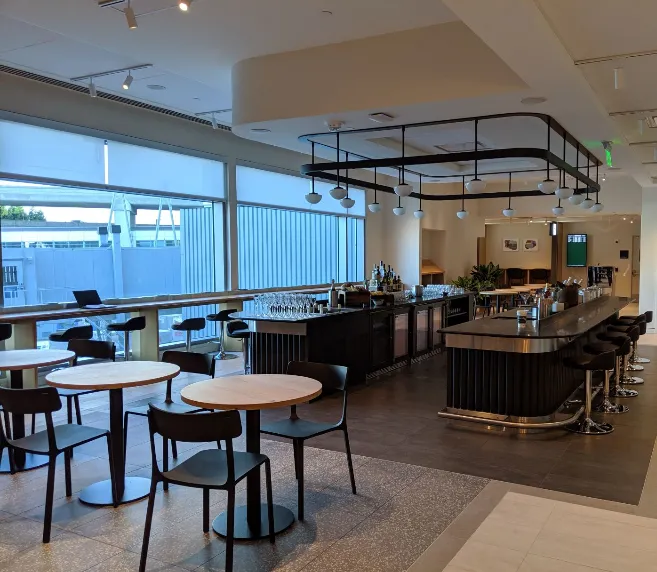
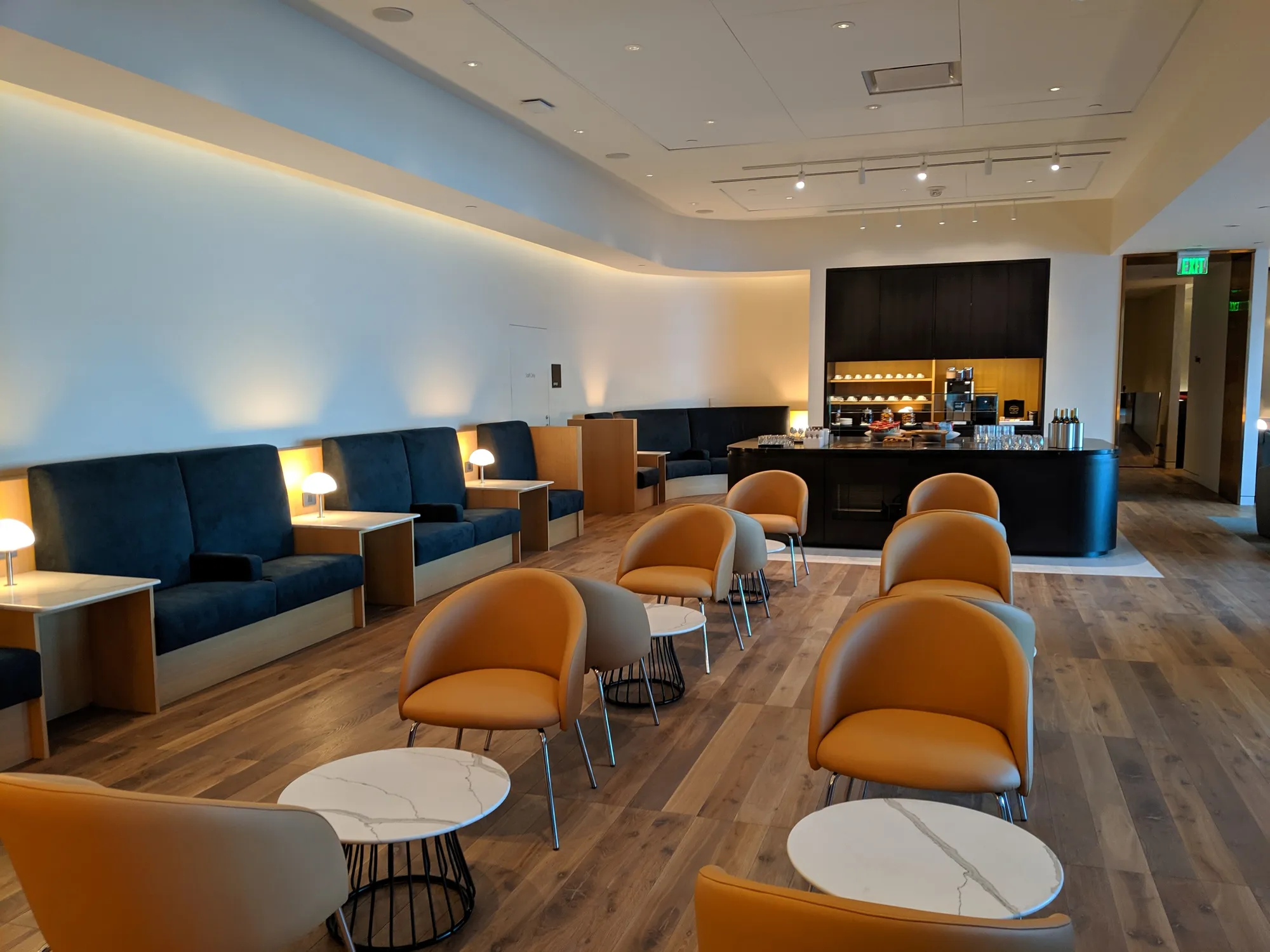
British Airways Lounge at San Francisco International Airport, image courtesy of oneworld
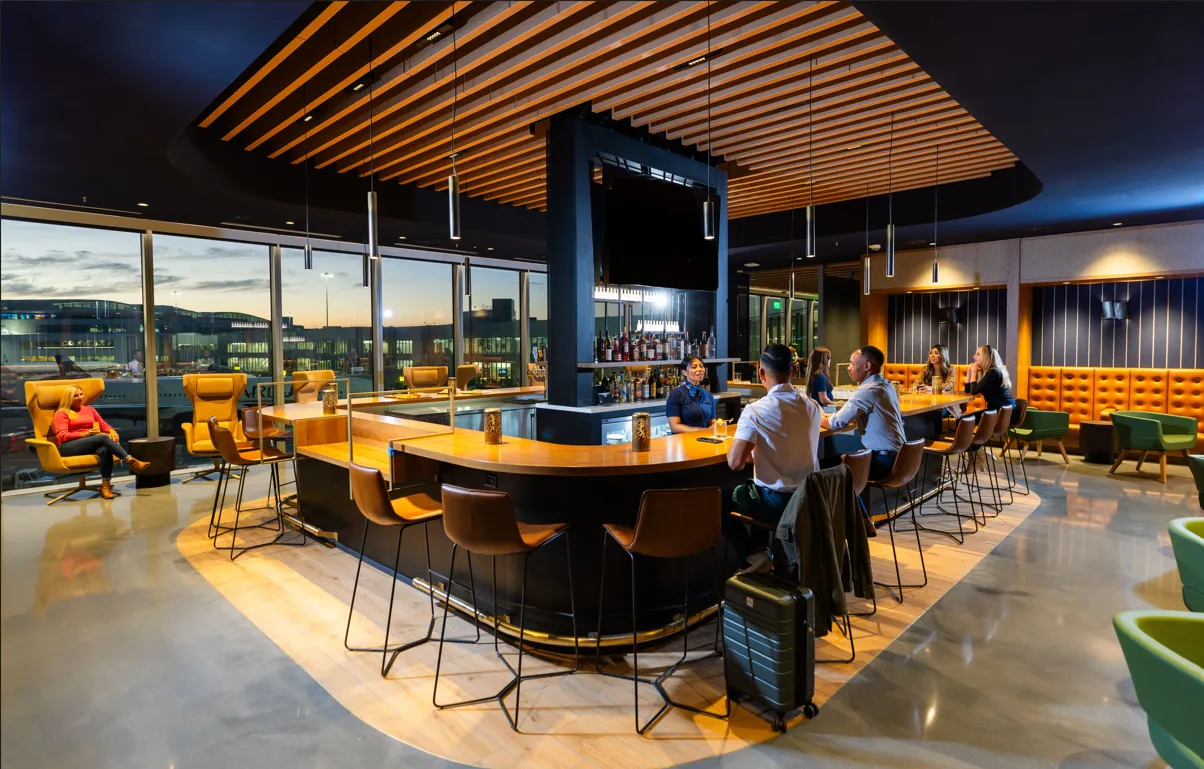
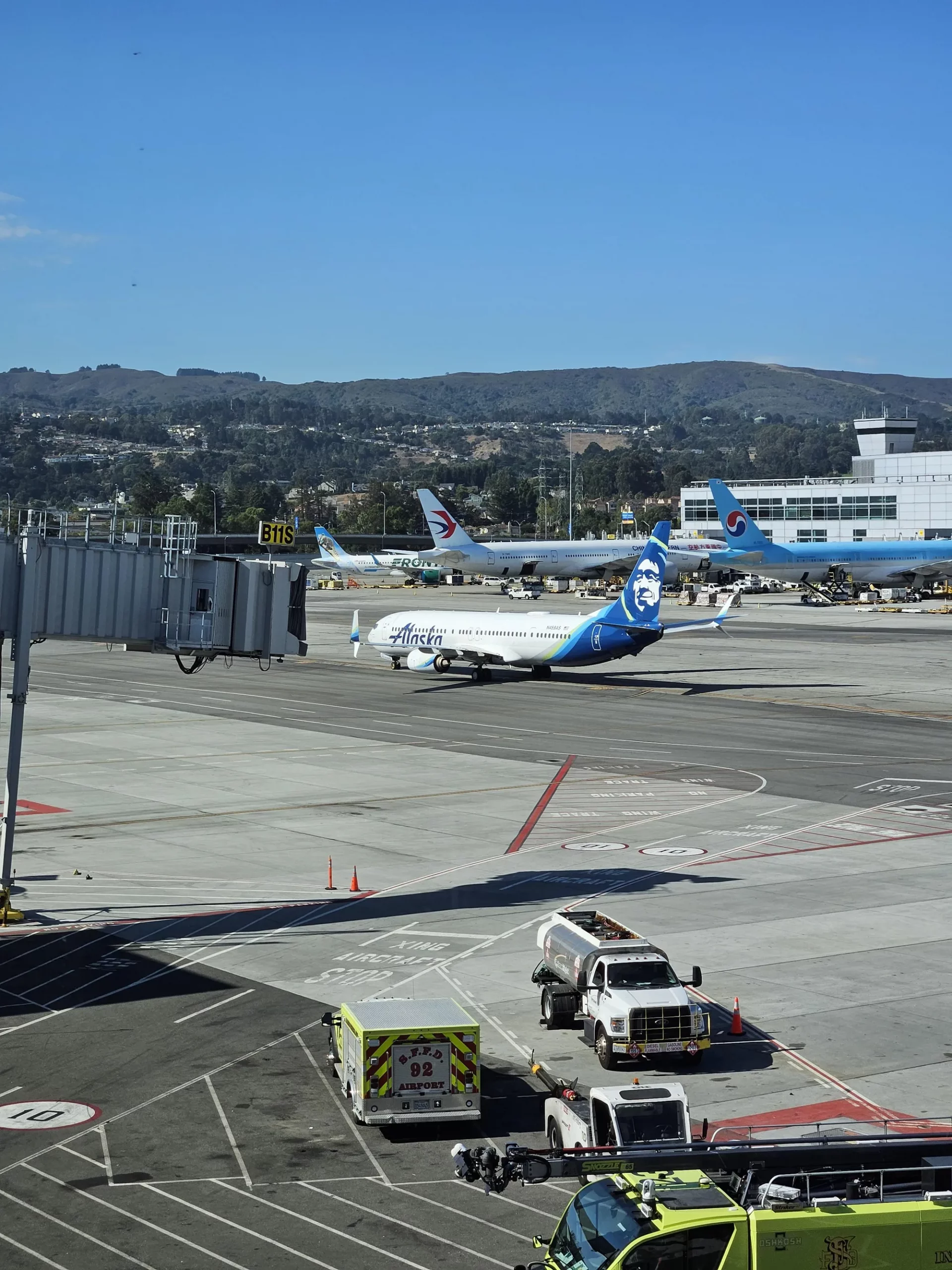
Alaska Lounge at San Francisco International Airport, image courtesy of oneworld (left); view from the Alaska Lounge (right)
Before COVID-19, JAL operated its own Sakura Lounge in San Francisco, but it now uses the British Airways lounge, another oneworld member’s lounge. Both First Class and Business Class passengers use the same lounge. It was smaller than I expected, and with several oneworld airlines using it around the same departure time, it felt a little crowded. I generally do not expect airline lounges in the US to offer the kind of food found in Asian lounges. There were some basic snacks and alcoholic drinks, but that was about it. If you have more time, I would recommend visiting the Alaska Lounge. With a same-day Business Class or First Class ticket on a oneworld airline, you can also use lounges operated by other oneworld airlines at San Francisco Airport. These include American Airlines’ Admirals Club, the Alaska Lounge and the Cathay Pacific Lounge. Personally, I would choose the Alaska Lounge. The food is nothing particularly special there either, but it feels more spacious and comfortable than the other lounges, and the view over the airport apron is good. Premium alcohol costs extra, but basic alcoholic drinks and local beers are complimentary. The downside is the roughly 15-minute walk from JAL’s International Terminal to the Alaska Lounge in Terminal 1. But after eating in the lounge, a little walk before another meal on the plane does not sound too bad.
9. Boarding Process
Boarding for JL57, scheduled to depart at 1:30 p.m., began at 1:00 p.m. Pre-boarding came first, followed by Group 1. Since this Boeing 787-8 had no First Class, Group 1 would have been JAL’s top-tier members and oneworld Emerald members. I boarded with Group 2, and there was nothing particularly unusual about the process. After I took my seat, a flight attendant came over, introduced himself and served JAL’s signature drink, Sky Time, as a welcome drink. It is a grape and peach juice with that sweet, candy-like taste that is strangely addictive. One thing puzzled me, though. The male flight attendant who introduced himself spoke some of the best English I had heard from a JAL crew member. I thought communicating would be easy on this flight, but after that greeting, I never saw him again before getting off the plane. What was the point of the introduction, then? That was a first for me. The aircraft door closed ten minutes before departure, and we departed right on time. JAL and ANA’s punctual boarding and departures always impress me.
10. Cabin & Seat Detail
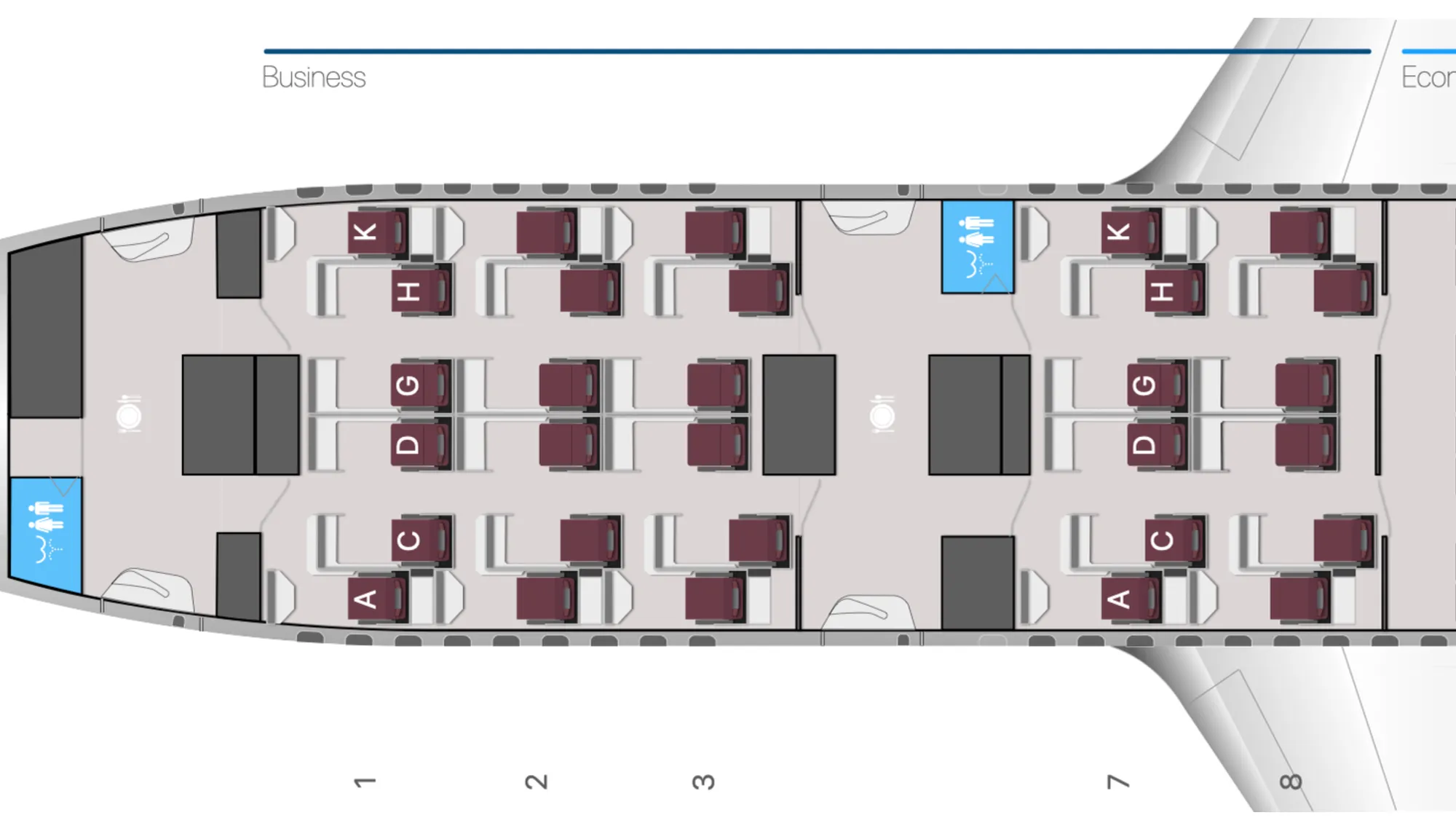
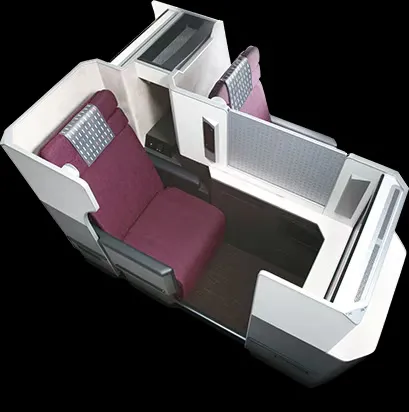
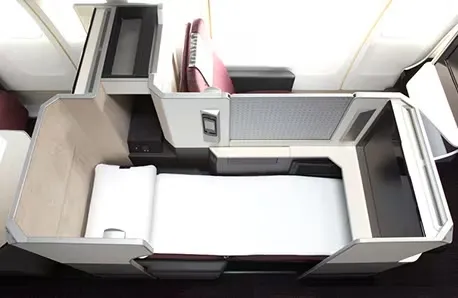
JAL Boeing 787-8 Apex Suite Business Class seat map, image courtesy of aeroLOPA / JAL Sky Suite (Collins Aerospace Apex Suite), image courtesy of JAL
JAL has two types of Business Class seats on its Boeing 787-8s. One is the JAL Shell Flat Neo, which was also often used on the Gimpo–Haneda route. It reclines to 171 degrees rather than becoming fully flat and is mainly used on shorter routes from Japan. My aircraft had JAL SKY SUITE seats, which are Collins Aerospace Apex Suites. They have a 2-2-2 layout, offer more legroom than herringbone or reverse-herringbone seats and convert into fully flat beds. They are the same seats as Korean Air’s Prestige Sleeper. The generous legroom is a benefit, but storage around the seat is limited. When I use this seat, I usually keep my belongings in a bag under the footrest. Window seats have some space behind them, but I have to get up to reach it. This also applies to the middle seat in the center block on JAL’s Boeing 777-300ER, which has a 2-3-2 layout. The aisle seats, on the other hand, have a useful storage area and side table beside the headrest, although the window seats have a slightly larger surface in front of the monitor. These seats can also be a little awkward for couples or passengers traveling with an infant. Lowering the divider lets you see the person beside you, but there is still a strong feeling of being in separate spaces. For solo passengers who need more storage space, I would recommend an aisle seat in one of the outer pairs rather than the center pair. If storage is less important, I would choose a window seat. For anyone traveling together, I would recommend the two center seats. I always complain about the lack of storage and then choose a window seat anyway. There was not much to see on this flight, though, as we spent the whole journey crossing the Pacific in daylight. For the winter schedule starting in late October 2024, this flight uses the slightly larger Boeing 787-9 instead of the 787-8 I flew on. It also has JAL SKY SUITE seats, but unlike the 787-8, it includes a Premium Economy cabin. JAL also provides mattress pads in Business Class on request. On an overnight flight, I would recommend asking a flight attendant for one to place over the flat seat. They are usually stored in the overhead bins. Since mine was a daytime flight and I was not planning to sleep much, I did not request one.
11. In-flight Service
On JAL’s long-haul Business Class flights, meal service starts soon after takeoff. The flight attendants come through the cabin to take food and drink orders, followed by a pre-meal drink and a small bite, an appetizer, the main course and dessert. After the meal, they offer onboard duty-free shopping. You do not have to buy anything during that particular service, though. You can ask a flight attendant at another time too. Once duty-free service finishes, the cabin lights are turned off. On an evening departure from the US to Asia, or a flight from Asia to the US, this would be a good time to sleep. But JL57 leaves and arrives during the day, making the timing a little awkward. We would land at around 4 p.m. Tokyo time, which is roughly 1 a.m. on the US West Coast, so getting a full sleep on the flight was not particularly easy. From this point until about 90 minutes before landing, passengers can order from the à la carte menu. The crew may not always come around to ask whether you want a meal before arrival. So if you do, I would recommend placing your order about two hours before landing. The flight attendants were friendly, as I would expect from JAL, although communicating in English sometimes took a little time. With only 186 passengers at full capacity, the aircraft did not seem to have a particularly large crew. There appeared to be about four flight attendants looking after Business Class and another four in Economy. This did not have much effect on the service overall, but things slowed down when several passengers needed service at once.
12. Amenities & Lavatory
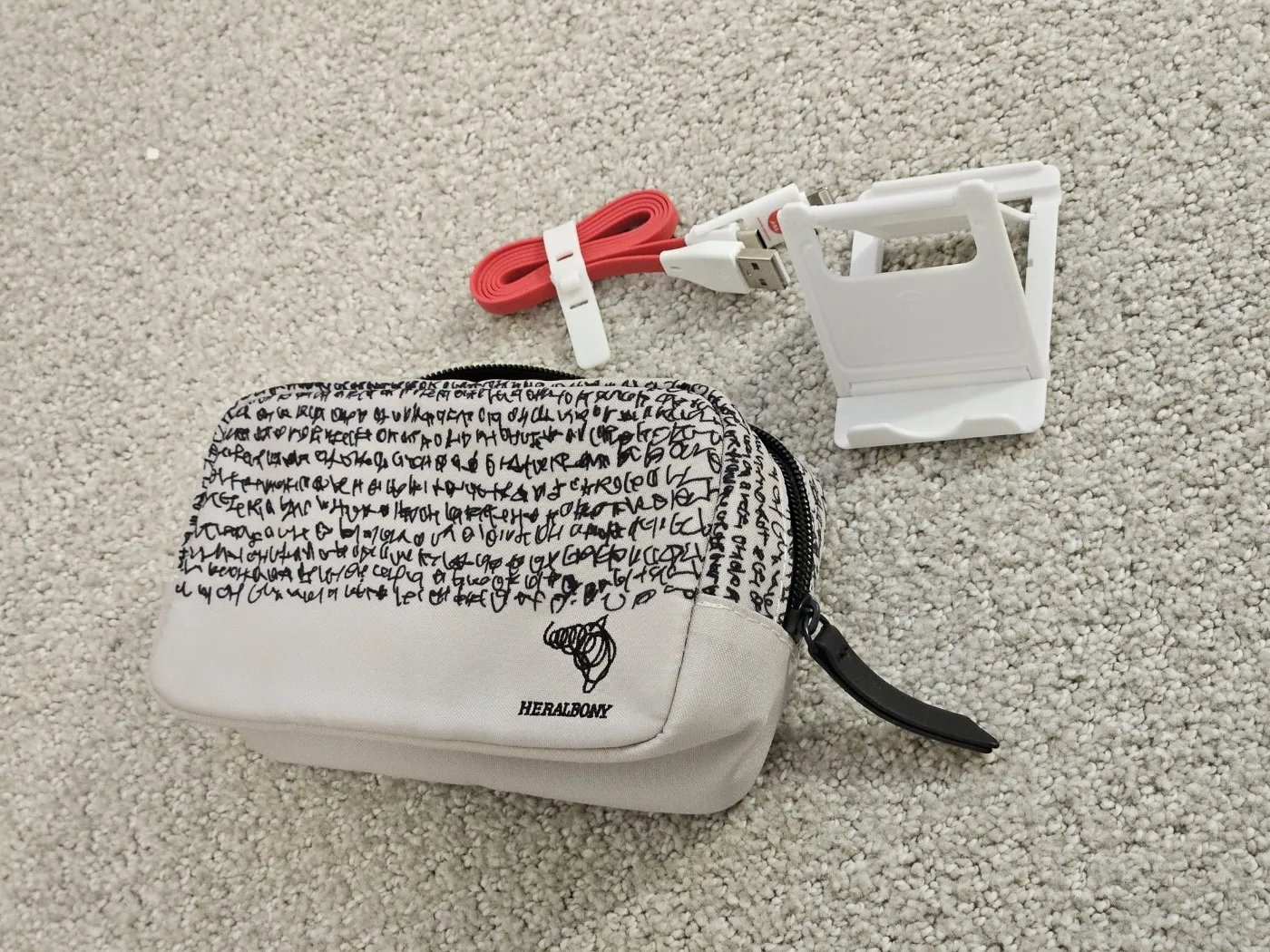
japan-airlines-b788-business-jl57-sfo-nrt-en-08
JAL HERALBONY amenity pouch, phone stand and charging cable
An amenity kit was provided for the long flight. This time, I received a kit from the Japanese brand HERALBONY. I had not heard of it before. Founded in 2018, it is described on JAL’s website as “an experimental welfare company,” and the amenity pouches feature artwork by different designers. The kit contained basics such as toothpaste, a toothbrush, tissues, earplugs and an eye mask. Two interesting additions that I had not seen before were a USB cable and a phone stand. The stand was especially useful for watching Netflix shows I had downloaded, as I could not find much I wanted to watch on JAL’s entertainment system. I also liked the cable in JAL’s signature red. One disappointment was that I remembered the kits having items such as facial mist or lotion in the past, but these seem to be disappearing. Meanwhile, JAL’s First Class kits still include lip balm, hand lotion and even Shiseido skincare products. Cardigans are also available on request. I used mine as a lap blanket when I was not using the bedding.
The 30 Business Class passengers share two lavatories: one at the very front of the aircraft by L1 and another by the Business Class galley at R2. They were fairly ordinary, but the crew seemed to clean them frequently, as they never felt dirty when I used them. Lotion was available in the lavatories, even though it was missing from the amenity kit. There were also bidet toilets, as I would expect on a Japanese airline.
13. Food & Beverage
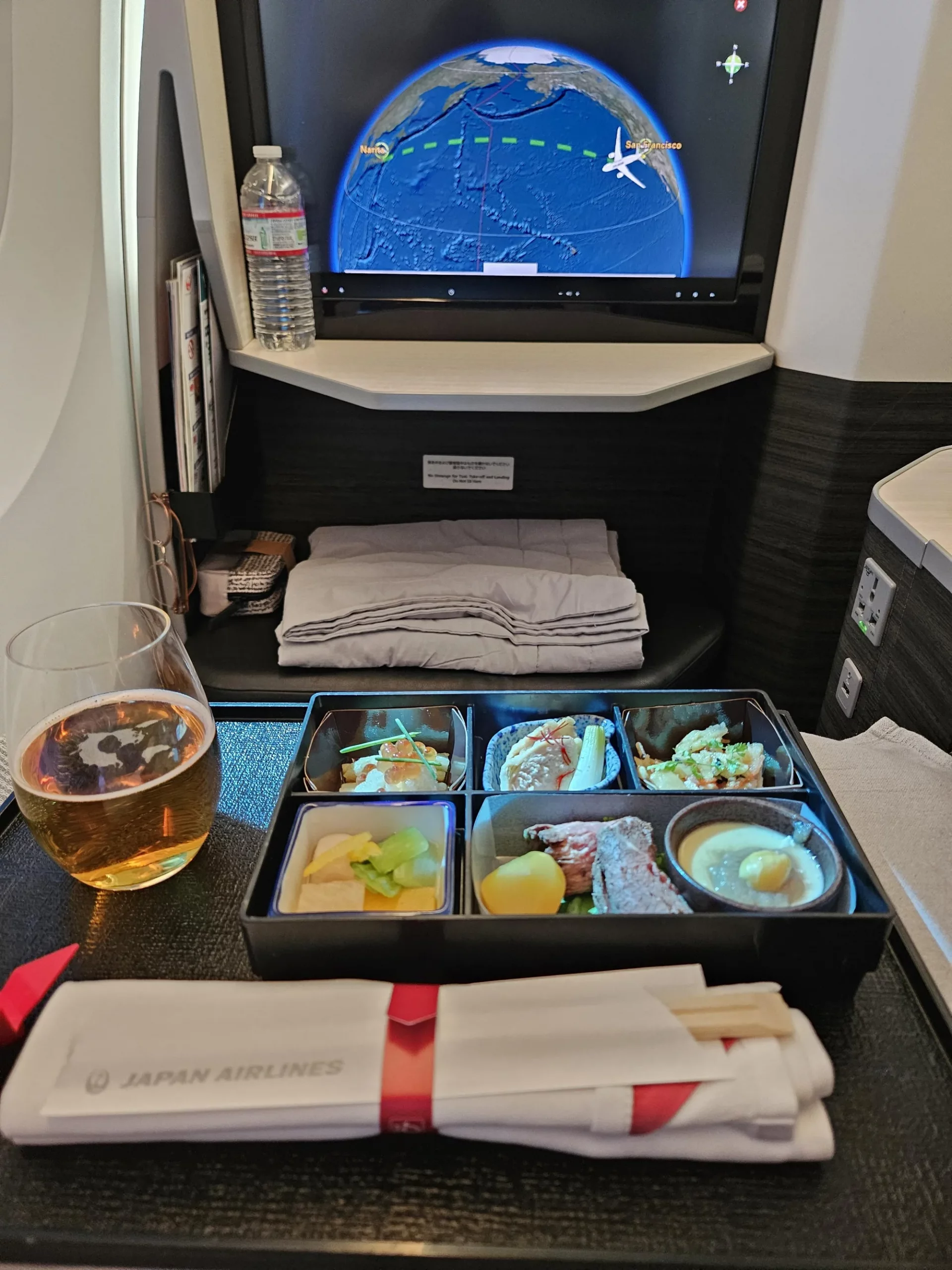
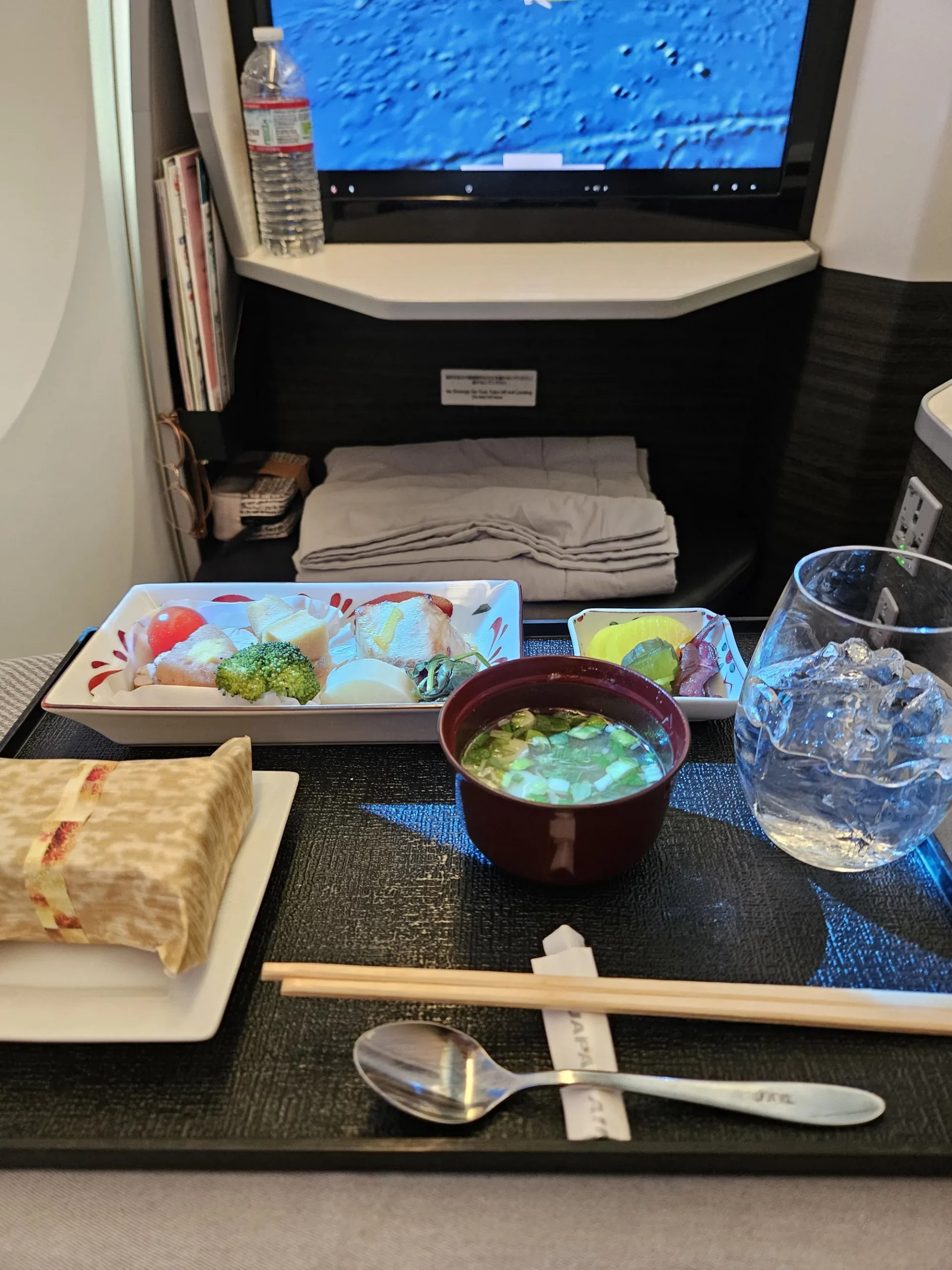
JAL Business Class meal
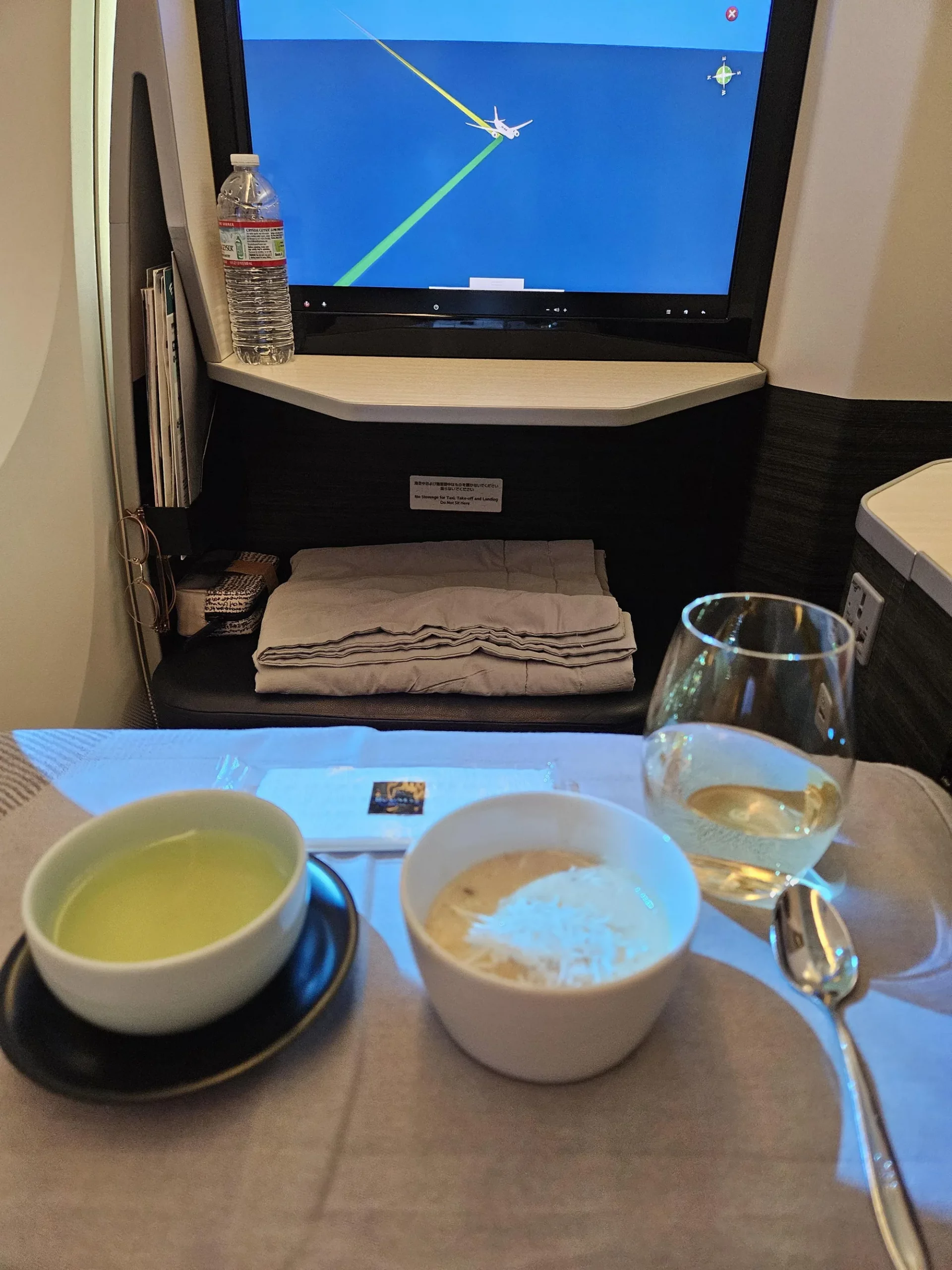

JAL Business Class meal / JAL Business Class snack
JAL Business Class snack
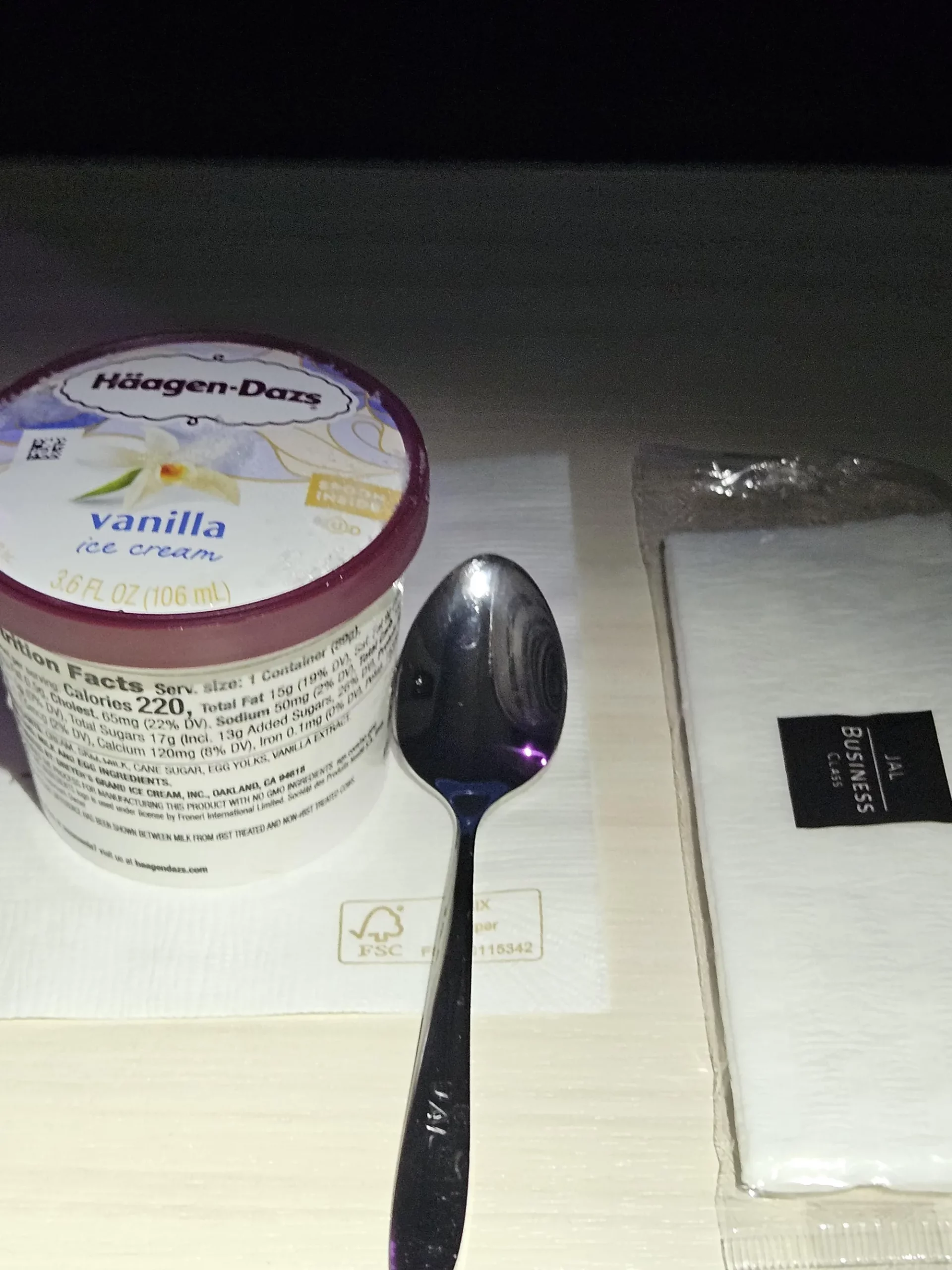
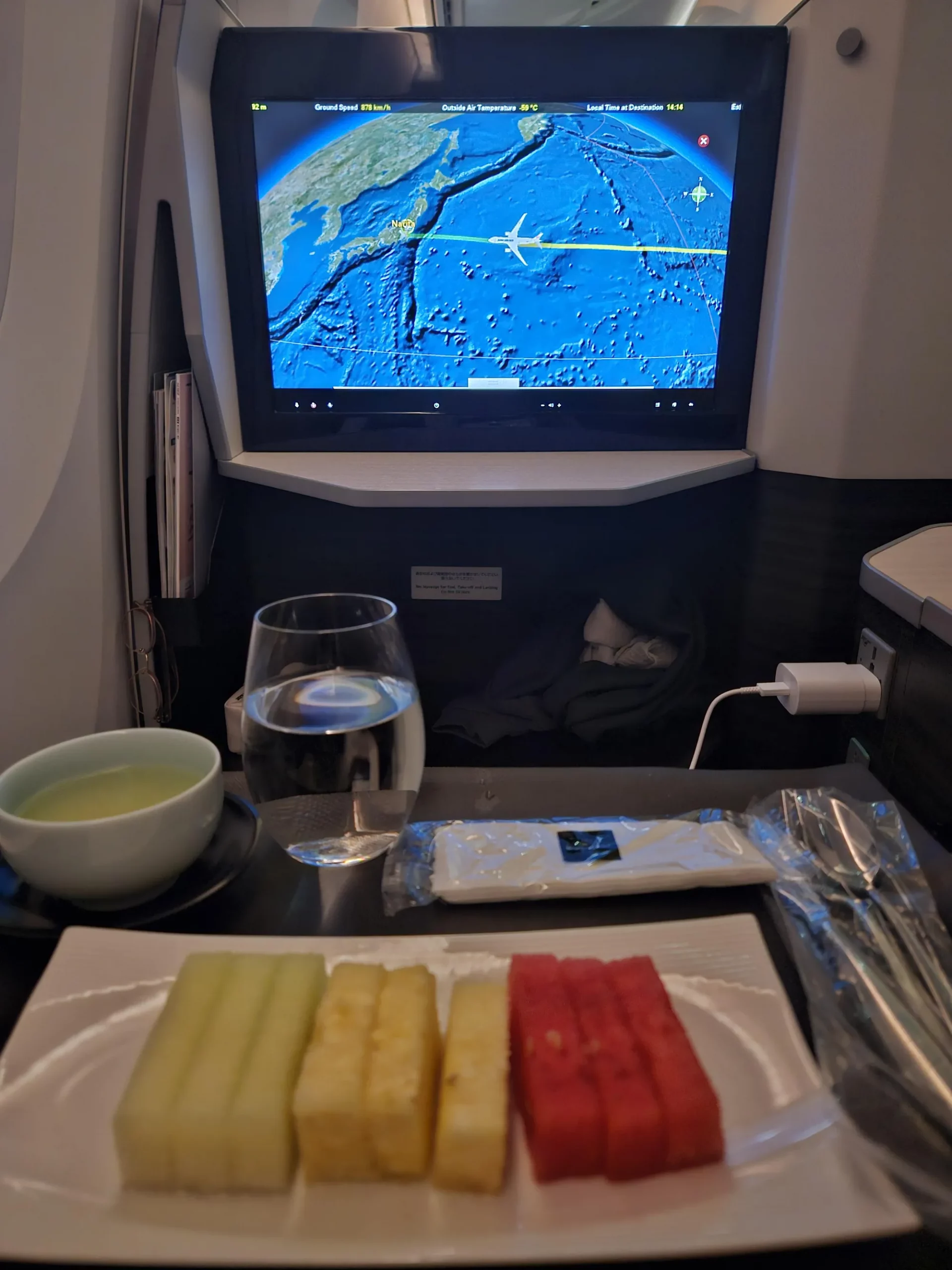
I think food is one of JAL’s strengths. I am not sure how Japanese passengers would rate the Japanese meals, but I have never been disappointed with them. I chose the Japanese menu again on this flight. I tried the Western menu once and did not find it particularly impressive compared with other airlines, so I have ordered Japanese meals ever since. But do not expect sushi or sashimi. Think vegetables, cooked fish and meat dishes instead. The appetizer included bite-sized portions of pickled vegetables, roast beef rolls and chicken. The main course was grilled yellowtail seasoned with soy sauce, along with boiled pork that reminded me of Korean suyuk. Looking back, there was quite a variety of protein on this tray: chicken, beef, pork and fish. The main came with miso soup, rice and pickled vegetables. Dessert was vegan coconut rice pudding served with green tea. The pudding had a pleasant, slightly nutty flavor. The à la carte menu included a prosciutto sandwich with truffle, mascarpone and Brie, a crab omelet rice bowl, vegetable curry and Japanese ramen. Cheese, fruit and ice cream were also available as snacks. I ordered the crab omelet rice bowl and ramen between meals. The rice bowl was lightly seasoned, so the egg and mushroom flavors came through clearly. It almost had the mild taste of a vegan dish, and I think anyone who prefers less strongly seasoned food would enjoy it. The ramen was tonkotsu miso ramen. At first, it tasted so mild that I wondered whether it was shoyu ramen, but as I ate, I realized the soup seasoning had settled at the bottom. I would definitely recommend stirring it well before eating. After finishing with vanilla Häagen-Dazs, I was far too full. I skipped the meal before landing and just had some fruit instead. The meal I missed was Chilean sea bass teriyaki, which I now find myself thinking about as I write this. Whenever I talk about airline food, I always end up mentioning Korean Air Business Class. On Korean Air, I eat Shin Ramyun because there is not much else I want. On JAL, there is so much I want to try that I cannot eat it all. Every time. If you fly JAL, I would definitely recommend the Japanese menu. Airline steaks tend to taste much the same anyway.
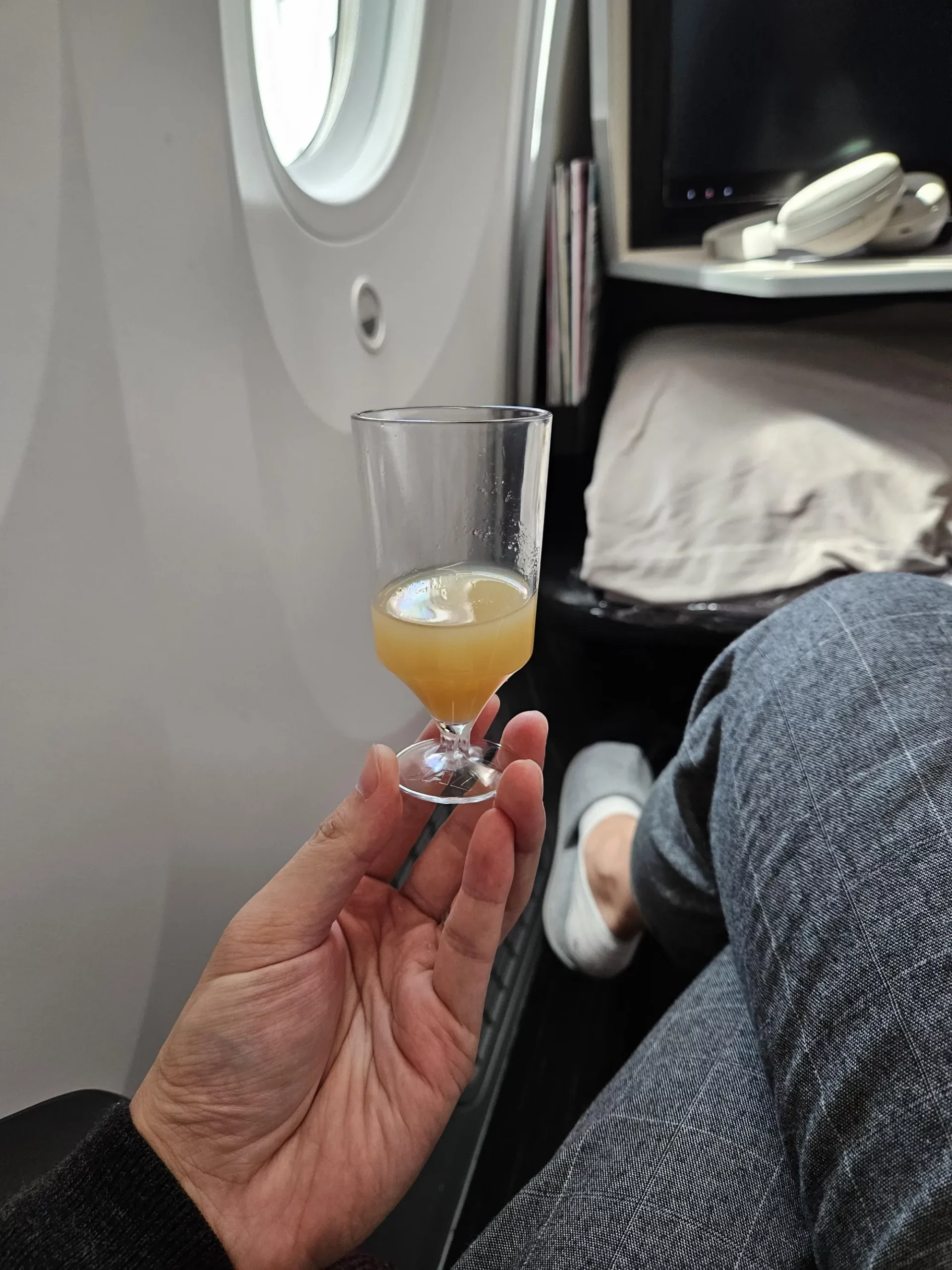
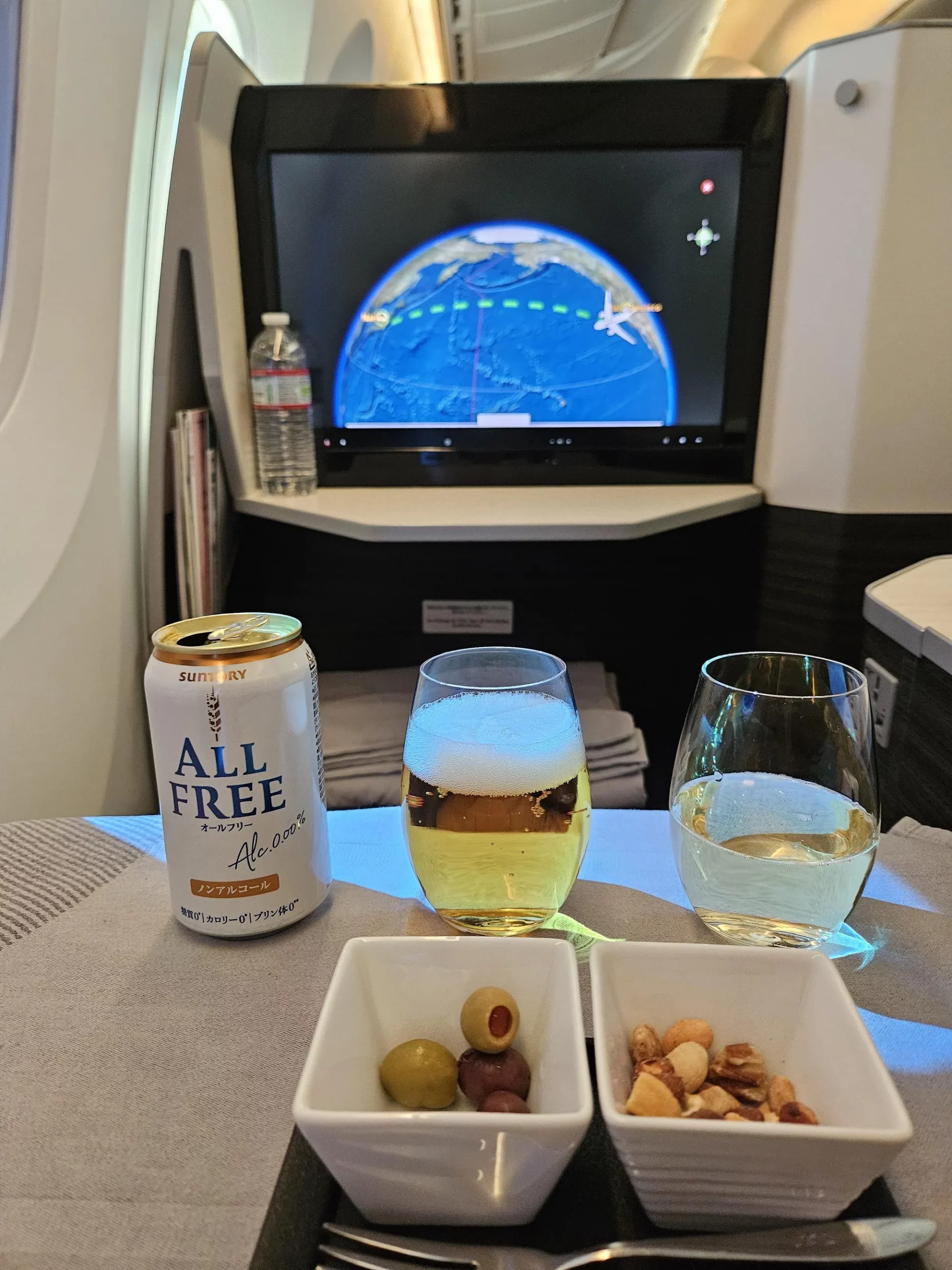
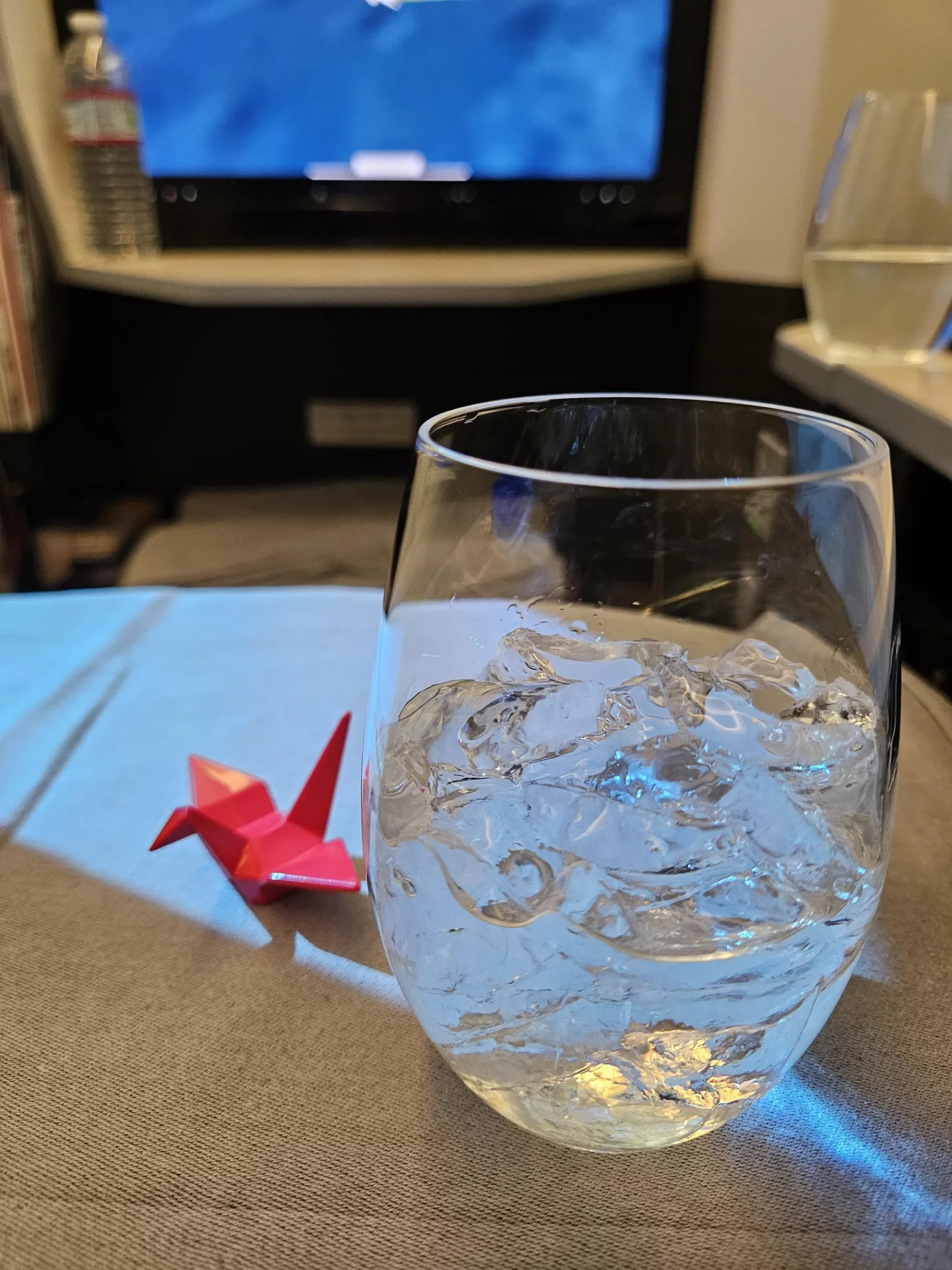
JAL’s Sky Time welcome drink (left); sparkling wine, alcohol-free beer and finger food (center); sweet potato shochu and a JAL crane (right)
Nothing on JAL’s Business Class alcohol list stands out as particularly exceptional. The whisky, cognac and other spirits are not especially high-end. But I always appreciate the sake and sweet potato shochu. I really like the distinctive aroma of sweet potato shochu, and since JAL and ANA are the only airlines that serve it, I always order some when flying JAL. It is not a particularly expensive one, though. There is a basic selection of Champagne, red and white wines, including Japanese wines. Cocktails include a Martini, Bloody Mary and Garibaldi, and Japanese beer is available too. I was disappointed that there was no port wine. I also tried the alcohol-free beer, Suntory ALL-FREE. Served with ice, it tasted a little like cold, fizzy barley tea, which I actually quite liked. There was alcohol-free sparkling wine as well, but I was not brave enough to try it.
For non-alcoholic drinks, there is Sky Time, which I had as my welcome drink. It also tastes good mixed with tonic water, listed on the menu as “Peach & Grape Fizz.” On JAL, I would recommend green tea or hojicha over coffee. There is plenty of discussion about aircraft water tanks, but I have never felt unwell after drinking the water, so I still enjoy hot drinks onboard. JAL’s drink selection is nothing exceptional, but it covers the basics without any obvious gaps. If you enjoy Japanese alcohol, the sake, plum wine, Japanese wine, sweet potato shochu and barley shochu could make it a good selection for you.
14. In-flight Entertainment & Wi-Fi
The weakest part of JAL is its onboard entertainment. There are not many movies I want to watch. The only one I watched was Inside Out 2. The selection mainly consisted of Marvel movies and older classics, and it did not give me the feeling that I could finally catch up on films I had wanted to see. Still, the screen was large enough to watch comfortably, and the remote was in good condition. The remote also had a small screen, but it was too small to be particularly useful. If you like relaxing music, the New Age playlists are fairly decent. But I think downloading something from Netflix before the flight is probably the best option.
15. Landing & Immigration
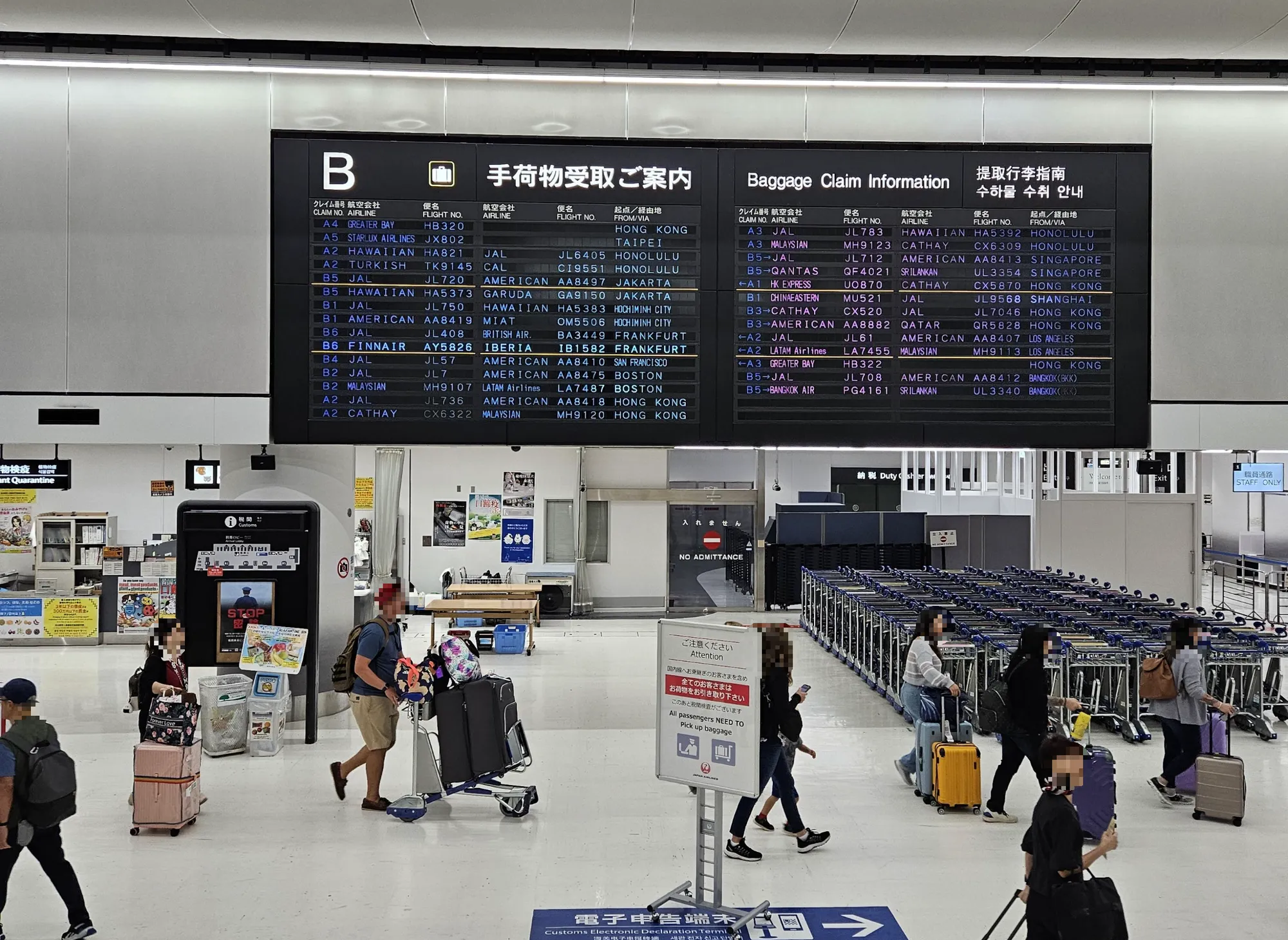
japan-airlines-b788-business-jl57-sfo-nrt-en-18
Tokyo Narita International Airport
Before landing, JAL hands out steam eye masks, which are surprisingly nice. You can use one during the descent or save it for bedtime that night. JAL arrives at Terminal 2 at Narita. It had been so long since my last visit that I could not really remember what it was like before, but the immigration line was short, and I got through quickly. My bags also arrived without any issues. One thing I often notice is that JAL seems to add priority tags to each bag during connections. When I collect my bags, they have tags that were not there when I checked them in. I used Haneda and Narita about a week apart on this trip. Immigration at Haneda was a nightmare, while Narita was easy, but I suspect this was simply because fewer flights arrived around the same time as mine.
16. What Could Be Better
JAL is not an airline where the disappointments stand out. After a flight, I usually feel that I have eaten well, rested well and arrived comfortably. If I had to name a weakness, the entertainment would be the biggest one. Communication in English can also be difficult at times. But when that happens, the flight attendant feels sorry for not understanding me, and I feel sorry for not making myself understood. It usually feels more awkward than inconvenient. On this flight, the smaller disappointments were the lack of port wine, which I enjoy, and the ramen seasoning settling at the bottom. Since I did not realize it needed stirring, the soup started bland and became salty toward the end. The SKY SUITE seat is still comfortable, but with so many new Business Class seats appearing, it is gradually starting to feel like an older product. None of these issues was serious enough to make this a poor Business Class experience. But they do make it difficult to call it the best.
17. Final Thoughts & Conclusion
Even so, I still prefer flying JAL Business Class to Korea, even if it means connecting in Tokyo. Korean Air has the advantage of a nonstop flight, but taking a shower and having a meal during a Haneda connection before flying into Gimpo is not a bad option either. Flying JAL Business Class also makes Korean Air’s limited snack menu feel disappointing by comparison. That does not mean I would recommend connecting on JAL over a nonstop Korean Air flight to everyone. A nonstop is much more convenient in most cases, and JAL Business Class can be expensive on a cash ticket, even with a connection. But if you get a chance to try it, I would recommend it, especially if you enjoy Japanese food and drinks.
The Editor Behind This Journey: Heejung

Have any questions or similar experiences? Please feel free to share them below.
Share this story to inspire another journey.
More Journeys to Explore
🗓️ Apr 2026 Stay | 🌏 Kuala Lumpur, Malaysia | 🛏️ St. Regis Suite
9/10 (🌕🌕🌕🌕🌗) Spacious, luxurious rooms, excellent breakfast, and thoughtful hospitality throughout the hotel made for a memorable stay. While poor advance communication about facility closures and a few operational shortcomings were disappointing, the staff's flexibility and genuine care delivered an experience that came remarkably close to a perfect 10.
🗓️ Feb 2026 Flight | 💺 Main Cabin Extra | ✈️ B777-200ER
7/10 (🌕🌕🌕🌗🌑) Thanks to the Main Cabin Extra seats, it was a practical long-haul economy flight that made the nearly 13-hour journey relatively manageable. The old aircraft, narrow seat width, and small meal portions were a letdown, but considering the lounge access and free seat selection benefits, it was a totally acceptable flight.
🗓️ Apr 2026 Stay | 🌏 Taipei, Taiwan | 🛏️ Standard King
10/10 (🌕🌕🌕🌕🌕) Mandarin Oriental Taipei delivers an exceptional luxury experience with spacious rooms, refined service, an excellent breakfast, elegant afternoon tea, and impressive facilities. While rates are premium, the overall quality and consistency easily justify the price, making it one of Taipei’s finest luxury hotels.
🗓️ Jan 2025 Flight | 💺 Prestige Sleeper | ✈️ A380-800
7/10 (🌕🌕🌕🌗🌑) The meal and service were perfectly adequate for a short-haul Prestige flight, but the more than decade-old A380 Prestige Sleeper seat and outdated inflight entertainment were major disappointments. The spacious atmosphere unique to the A380 was enjoyable, but the flight felt as though Korean Air’s business class had been frozen in time.